 |
||||||
 |
 |
 |
Institute for Theoretical Physics | |||
statistical mechanics group|
leonardo
|
||||||
|
||||||
|
||||||
|
||||||
|
||||||
|
|
|
Institute for Theoretical Physics | |||
|
statistical mechanics group|
leonardo
|
||||||
|
||||||
|
||||||
|
||||||
As a first test of Tina's performance we apply the well known Linpack benchmark. Linpack requires the solution of a system of N linear equations with N unknowns. There are several versions the Linpack benchmark, differing in size, numerical precision, and rules.
The reported results have been achieved with gcc 2.95.2.
The basic benchmark is the N=100 double precision benchmark,
where you are allowed to use whatever compiler optimizations you have at your disposal,
but you cannot modify the sourcecode. We used
linpackc.c, the C version of
the 100x100 Linpack.
Compiler options are -DDP -DUNROLL for double precision and loop-unrolling
and
-O3 -ffast-math -fexpensive-optimizations -march=i686 -mcpu=i686
for optimization. With that we get 295 Mflops on a single processor.
As you might have guessed, here N=1000. The major feature of the 1000x1000 Linpack is that you are allowed to modify the source code. All modifications are permitted, as long as your solver returns a result which is correct within the prescribed accuracy. We take the solver from the ATLAS library that comes with Debian. With that we get 460 Mflops for N=1000 and 528 Mflops for N=5000.
This is the benchmark that (hopefully) gets you into the Top 500 list of worlds fastest supercomputers. In the parallel version, you are allowed to modify the source code and to adjust the size of the problem to get optimal performance.
We used HPL, a easy to use parallel Linpack based on MPI.
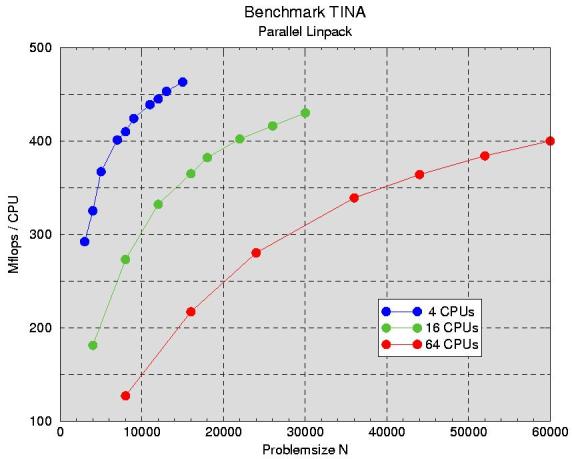 |
The parallel solution of a system of linear equation requires some communication between
the processors. To measure the loss of efficiency due this communication, we solved
systems of equations of varying size on a varying number of processors. The general rule is:
larger N means more work for each CPU and less influence of communication. As you can
see from Fig. 1, a 4-CPU setup comes very close to the single CPU
peak performance of 528 Mflops. This indicates, that the solver that works in HPL is not significantly
worse than ATLAS. The relative speed per CPU decreases with increasing number of CPUs, however.
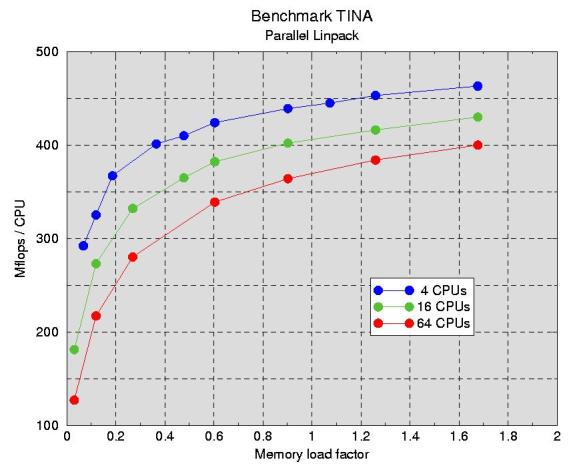 |
The problem size N is limited by the total memory. Tina has 512 MByte per node, i.e.
each node can hold at most an 8192x8192 matrix of double precision floats. In practice, the matrix
has to be smaller since the system itself needs a bit of memory, too. If both CPUs on a node are
operating, the maximum size reduces to 5790x5790 per CPU. To minimize the relative weight of
communication, the memory load should be as high as possible on each node. In Fig.2 you can see, how
the effective speed increases with increasding load factor. A load factor 1 means that 256 MByte
are required on each node to hold the NxN coefficient matrix.
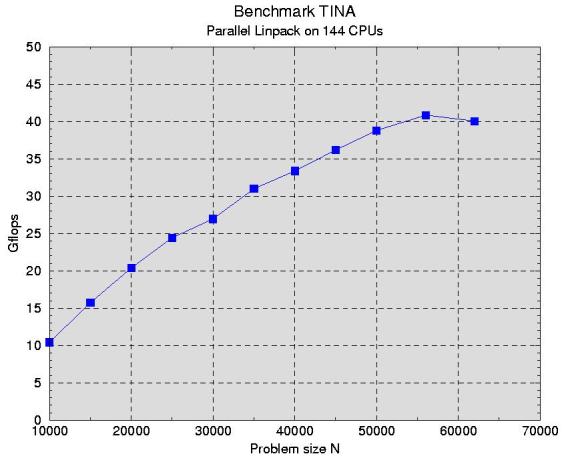 |
With all 144 CPUs, communication becomes the major bottleneck. The current performance of 41 Gflops scales down to 284 Mflops/CPU. The CPUs seem to spend almost half of their time chatting with each other...
We are still working to improve the communication, but the TOP 500 (at least 55 Gflops for the
current list, presumably 70 Gflops for the list to come) seems out of reach.

URL: http://tina.cryptoweb.de
Tuesday, August 11th 2026, 18:14:53 CET
